I love "AHA!" moments. It's a little like getting a late Christmas present or an unexpected birthday gift. Small epiphanies can occur at any time and show up anywhere. It's the "I coulda had a V-8" moment that leads the mind (and if lucky, the heart) into new thoughts and ways of thinking, new understandings and, quite possibly, actions.
In the book Uncommon Gratitude, written with Sr. Joan Chittister, the Archbishop of Canterbury, Dr. Rowan Williams, wrote of Father Joe, a priest with a very uncommon gift. It seems that Father Joe could listen with full attention to whatever someone was saying to him, giving them the feeling that what they said and thought, even their very selves, were of tremendous interest and importance. Whatever was said was heard with the ears and heart of kindness, compassion and understanding. I got the feeling that Father Joe, to use an old metaphor, could take the old suit of ideas that someone brought out of the closet, shake it, dust it off, give it a bit of a press and return it to the person, the same suit but somehow made new and useful once again. Archbishop Williams stated, "I've said that you would be taken seriously; at the same time, you would emphatically not be encouraged to take yourself seriously in the wrong way." *
What a tremendous gift to give to someone: undivided attention, more interested in what they say than what the response should be, acceptance of the person's position (whether or not there is a common agreement on the subject), and a response that honors the person yet sends them off considering a new spin on what they originally thought, headed in a new direction from the one in which they came.
I guess I'm like a lot of people; I often take myself too seriously. Maybe it is a defense mechanism because there's the old saw that if I don't take myself seriously, no one else will either. Maybe it's because when I hold the mirror up to myself I see little to lighten the soul and spirit. In any case, I've been fortunate (make that tremendously blessed) to have a few people around me at various times that took me seriously, offered a not always uncritical but usually very kind ear, and who could brush off the dust from my suit and refresh it before handing it back to me to put on. Quite often, without saying so, they encourage me not to take myself so seriously and their unspoken cautions often draw me up short.
There are times, however, when I offer something to someone that I feel is serious and important only to be brushed aside. I guess that's a sign that I'm taking myself (or my opinion or belief about something) too seriously. Sometimes it just seems more prudent to "Remain silent and be thought a fool than to open the mouth and remove all doubt." The trick is to know which to do when. And then there's the twist-- if I want to be listened to, I must cultivate the ability of active listening and offer that courtesy to others first.
Oh, how lovely it might be sometimes to have people hanging on my every word as if it were some special insight or words of wisdom, but dang it, that ain't how it is or how it will be. Everybody wants to feel important, to be appreciated, to be respected, but it's not necessarily something that is part of the person's DNA or even the product of their upbringing. A lot of it comes from experience and only living gives that breadth of experience.
Ok, I'm never going to be taken as seriously as I'd like, and Lord knows I need to take myself less seriously most of the time. So what now? Am I willing to listen with more energy than I spend trying to formulate an answer before the other person has finished speaking? Am I willing to prick the balloon of self-importance and occasional pomposity? Am I willing to open myself and be more vulnerable so that someone else can be taken very seriously without patting myself on the back for my virtuousness in so doing? Can I be serious without taking myself too seriously?
God knows ---- but I will have to find out.
( Chittister & Williams, Uncommon Gratitude, Kindle edition, loc. 749)
Monday, January 31, 2011


Monday, January 24, 2011
Theological Reflection
An integral part of EfM (Education for Ministry) is the theological reflection: taking a thought, an incident or event, a text, an artifact (movie, advertisement, cartoon, picture, painting, sculpture, etc) or a belief, and creating a discussion that includes not just what is immediately evident but what lies behind it, what draws it in, what it means theologically. It's a way of learning to think theologically, to see theological overtones and implications in ordinary things as well as in those weighty tomes and liturgical practices that often have the word "Theology" attached. Theological reflection is a process that goes on in a community setting although it can also be done as an individual.
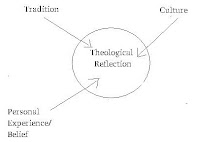 Many books on TRs bring in three main areas of input: tradition, culture and personal experience/ belief. Each has a place and adds to the depth of the conversation.
The Tradition source is that which comes from the past—scripture, church doctrine, church practice, other religions and religious texts, custom, and history—and the present, how the church and the community think and act currently. Much of tradition is the result of the hashing out of what a community or church believes, how it expresses and practices that belief and how it arrived at that belief, position or practice. The Bible is one aspect of Christian tradition while religious stories of the saints, legends, religious mythology (meaning, for me, stories of faith that may or may not be historically factual but in which truth is indelibly present) and texts such as the Book of Common Prayer create tradition in the religious sense.
The Culture component is comprised of those things which are encountered in the world. Movies, videos, books, magazines and advertisements, normal accepted practices within a specific group, and what the culture holds as important are parts of this source. Another form of tradition plays a part here as well since much of what is exhibited in a culture is that which they have derived and maintained from the collective past. Culture is continually changing, morphing as new discoveries, expressions, attitudes, practices and methods are made even though some aspects from the cultural tradition may remain viable and visible.
Personal experience also plays a part in the TR. This is where the personal history, events, knowledge, belief and position of the individual join that of the community with whom the conversation of TR is taking place. Personal includes tradition and culture through which the individual has grown, moved and changed, and how those things have formed the individual engaging in the TR conversation with others, all of whom have their own stories, strengths, knowledge, traditional and cultural input.
I think, though, that TRs based solely on these three elements, tradition, culture and personal experience, while valuable, somewhat miss the boat. One can meditate on one's own, sitting and contemplating the theological meaning of a beautiful scene, an artifact of some sort or even one's own navel lint but it can remain simply an intellectual exercise rather than something deeper with greater insights into a wider range. Even conversations in community can be intellectually stimulating but abstract. Much of the theological stuff which we study in EfM and elsewhere are the products of individual thought and reflection but it has seeped through the words of the thinkers into the language and customary of the religious society in which they lived, taught and worshipped. Some subsequently get discarded, others modified, and some remain more or less intact, but all came from one person's thoughts, beliefs, experiences, tradition and cultural expressions through conversation or interaction in some form with others
Hence EfM, in its wisdom, creates a fourth element to theological reflection.
 The Action quadrant takes the input from the other three quadrants and creates a result, something that grows out of the discussion into some sort of fruitful way. Not content to just discuss an idea or belief, the action portion asks penetrating questions: How to going to use the insights and ideas that have been discussed and experienced in the conversation? What can be done with this knowledge? What does this all mean to one's ministry and life? Where will the insights be applied and who or what is needed to support this endeavor? Yes, the other sections do have questions attached to them, but it is a fact-finding mission, one to show where one is at a given point in time, how one got there, where one got the ideas in the first place and from where the insights, beliefs, experiences and knowledge came. Action turns it around. Instead of putting information in, it encourages a looking-outward, a stepping stone to future action and faith.
Where did I come from? Where was I taught to think/believe this or that? Who or what influenced me? How did I come to this point in life and faith? Where do I go from here? What can I do to implement new insights I have gained through these conversations? Where do I fit into the ongoing work of building the kingdom and how can I contribute to its success? EfM's emphasis on TRs may not get me there but it won't be for lack of guidance, structure or discussion. It gives me the tools --- but it's up to me (with God's help) to do something with those tools.
And to think I used to think of TRs as wasted time when I'd rather have been discussing the texts. That's growth for you.

The Tradition source is that which comes from the past—scripture, church doctrine, church practice, other religions and religious texts, custom, and history—and the present, how the church and the community think and act currently. Much of tradition is the result of the hashing out of what a community or church believes, how it expresses and practices that belief and how it arrived at that belief, position or practice. The Bible is one aspect of Christian tradition while religious stories of the saints, legends, religious mythology (meaning, for me, stories of faith that may or may not be historically factual but in which truth is indelibly present) and texts such as the Book of Common Prayer create tradition in the religious sense.
The Culture component is comprised of those things which are encountered in the world. Movies, videos, books, magazines and advertisements, normal accepted practices within a specific group, and what the culture holds as important are parts of this source. Another form of tradition plays a part here as well since much of what is exhibited in a culture is that which they have derived and maintained from the collective past. Culture is continually changing, morphing as new discoveries, expressions, attitudes, practices and methods are made even though some aspects from the cultural tradition may remain viable and visible.
Personal experience also plays a part in the TR. This is where the personal history, events, knowledge, belief and position of the individual join that of the community with whom the conversation of TR is taking place. Personal includes tradition and culture through which the individual has grown, moved and changed, and how those things have formed the individual engaging in the TR conversation with others, all of whom have their own stories, strengths, knowledge, traditional and cultural input.
I think, though, that TRs based solely on these three elements, tradition, culture and personal experience, while valuable, somewhat miss the boat. One can meditate on one's own, sitting and contemplating the theological meaning of a beautiful scene, an artifact of some sort or even one's own navel lint but it can remain simply an intellectual exercise rather than something deeper with greater insights into a wider range. Even conversations in community can be intellectually stimulating but abstract. Much of the theological stuff which we study in EfM and elsewhere are the products of individual thought and reflection but it has seeped through the words of the thinkers into the language and customary of the religious society in which they lived, taught and worshipped. Some subsequently get discarded, others modified, and some remain more or less intact, but all came from one person's thoughts, beliefs, experiences, tradition and cultural expressions through conversation or interaction in some form with others
Hence EfM, in its wisdom, creates a fourth element to theological reflection.

Where did I come from? Where was I taught to think/believe this or that? Who or what influenced me? How did I come to this point in life and faith? Where do I go from here? What can I do to implement new insights I have gained through these conversations? Where do I fit into the ongoing work of building the kingdom and how can I contribute to its success? EfM's emphasis on TRs may not get me there but it won't be for lack of guidance, structure or discussion. It gives me the tools --- but it's up to me (with God's help) to do something with those tools.
And to think I used to think of TRs as wasted time when I'd rather have been discussing the texts. That's growth for you.
Wednesday, January 5, 2011
Another Goodbye
If you saw her you'd just see a little old lady, bent over with a hunched back, pushing a walker. Her skin was fair but very thin, bones visible under the frail wrapping. If you were the wondering kind, you'd wonder what stories she could tell, where she'd been, what her family was like, who loved her.
If you got to know her, you'd find that fragile frame held a young person in an old body. Despite twitching limbs and eyes glazed by near-total blindness, her mind was sharp and her memory intact. Ask her about her life and she had a million stories to tell, funny ones, sad ones, gripping ones. She'd lived long but had lived every minute to the hilt. She'd lived in far-off, exotic places, traveled widely and read even more widely than she'd traveled. She'd been a number of things: child, student, secretary, wife, mother, homemaker, florist, traveler, civic worker, avid gardener, tennis player, grandmother, great-grandmother and friend to people of all classes, from princes to domestic workers in many corners of the world.
There had been one man in her life, the man she'd married and with whom she'd shared 56 years of that marriage. They were partners in life and even after his death, his presence was with her. One of her sons told her of a visit to a place where she and her husband had lived not long after their marriage. "Wait until I tell Fred," she said. The son wondered how she was going to do that as his father had died some years before. I have no doubt Fred heard.
I met her because she wanted a job done that she couldn't do completely on her own and I'd had a bit of experience in that line. She had begun the project at least three or four years prior, dictating her stories onto tapes, lots of tapes. Over the course of nearly two years, we talked at least once a week and as I would be reading back what I'd transcribed and stopped for breath, she'd take over and repeat the next part of the story, word for word as she'd dictated them years before. That used to make me laugh and mock-scold her, "Hey, I hadn't gotten to that yet!" and then she would laugh with me. The happiest day came when I could finally put the product of her years of work into her hands. She laughed and waved her hands and feet in the air like an excited child. She'd completed her task and now others could read her stories, family stories, family traditions. I was honored to have been a small part in making that possible.
I never underestimated her. She might have been frail and elderly but she had an almost indomitable will. Not many 89-year-old women with severe osteoporosis could survive a fall that broke bones in her neck and not only survive but within 3 months be as active and mobile as before the fall. She had finished one project but it was time to move on to the next -- planning her 90th birthday parties the next spring. And plan she did, down to the details. She knew precisely what she wanted and that was how it was going to be. Well, almost. I don't think she planned on one little detail.
Her friends had planned an 80th birthday party for her with exquisite decorations and fantastic food. Unfortunately she spent the day in the hospital and missed the party because of gall stones and resulting pancreatitis. She will miss her 90th birthday party too, for a very different reason. Still, I have a feeling that there will be a tiara and a martini laid out for her and that somewhere she will be laughing about it.
Well, Ginger, you've begun the sequel to your book and I'm sorry I can't help you write this one. I will miss you. You might not always have had an easy life but you lived it to the fullest. You never gave up and I don't think you ever really gave in. You're a perfect lesson in what it is to drink from the cup of life and drink deeply. The world's a little darker without you in it, but I have a feeling that somewhere in heaven there's a party going on with tiaras, martinis, a good band and Fred.
Somehow I think you've heard me say all this. Thanks for sharing your life and family with me. We will meet again, I'm counting on it.
May God bless you as God always has blessed and loved you. May you rest in peace and most assuredly rise in glory. I have a feeling God would hear about any deviation from that plan. And I say that with all affection -- and confidence. Goodnight, Ginger -- for a little while.
If you got to know her, you'd find that fragile frame held a young person in an old body. Despite twitching limbs and eyes glazed by near-total blindness, her mind was sharp and her memory intact. Ask her about her life and she had a million stories to tell, funny ones, sad ones, gripping ones. She'd lived long but had lived every minute to the hilt. She'd lived in far-off, exotic places, traveled widely and read even more widely than she'd traveled. She'd been a number of things: child, student, secretary, wife, mother, homemaker, florist, traveler, civic worker, avid gardener, tennis player, grandmother, great-grandmother and friend to people of all classes, from princes to domestic workers in many corners of the world.
There had been one man in her life, the man she'd married and with whom she'd shared 56 years of that marriage. They were partners in life and even after his death, his presence was with her. One of her sons told her of a visit to a place where she and her husband had lived not long after their marriage. "Wait until I tell Fred," she said. The son wondered how she was going to do that as his father had died some years before. I have no doubt Fred heard.
I met her because she wanted a job done that she couldn't do completely on her own and I'd had a bit of experience in that line. She had begun the project at least three or four years prior, dictating her stories onto tapes, lots of tapes. Over the course of nearly two years, we talked at least once a week and as I would be reading back what I'd transcribed and stopped for breath, she'd take over and repeat the next part of the story, word for word as she'd dictated them years before. That used to make me laugh and mock-scold her, "Hey, I hadn't gotten to that yet!" and then she would laugh with me. The happiest day came when I could finally put the product of her years of work into her hands. She laughed and waved her hands and feet in the air like an excited child. She'd completed her task and now others could read her stories, family stories, family traditions. I was honored to have been a small part in making that possible.
I never underestimated her. She might have been frail and elderly but she had an almost indomitable will. Not many 89-year-old women with severe osteoporosis could survive a fall that broke bones in her neck and not only survive but within 3 months be as active and mobile as before the fall. She had finished one project but it was time to move on to the next -- planning her 90th birthday parties the next spring. And plan she did, down to the details. She knew precisely what she wanted and that was how it was going to be. Well, almost. I don't think she planned on one little detail.
Her friends had planned an 80th birthday party for her with exquisite decorations and fantastic food. Unfortunately she spent the day in the hospital and missed the party because of gall stones and resulting pancreatitis. She will miss her 90th birthday party too, for a very different reason. Still, I have a feeling that there will be a tiara and a martini laid out for her and that somewhere she will be laughing about it.
Well, Ginger, you've begun the sequel to your book and I'm sorry I can't help you write this one. I will miss you. You might not always have had an easy life but you lived it to the fullest. You never gave up and I don't think you ever really gave in. You're a perfect lesson in what it is to drink from the cup of life and drink deeply. The world's a little darker without you in it, but I have a feeling that somewhere in heaven there's a party going on with tiaras, martinis, a good band and Fred.
Somehow I think you've heard me say all this. Thanks for sharing your life and family with me. We will meet again, I'm counting on it.
May God bless you as God always has blessed and loved you. May you rest in peace and most assuredly rise in glory. I have a feeling God would hear about any deviation from that plan. And I say that with all affection -- and confidence. Goodnight, Ginger -- for a little while.
Friday, December 31, 2010
Books and Bookstores
Where is nature so weak as in the bookstore? -- Henry Ward Beecher
I confess. I'm a bookaholic. I always have more books than I will probably ever read and spend more on books than I truly ought, but I can't help myself. I hear of an interesting book and I'm off to find it at B&N, Borders, Amazon, Alibris or anywhere I can find it.
When I moved from the house in Litchfield, I donated 23 boxes of assorted books to the library for its annual sale. Some of them were so hard to part with like my full set of Anne McCaffrey's dragon series, while others were books that I'd read years before and really just needed to get rid of. Mysteries, thrillers, cookbooks, a few biographies, a few nonfictions, and a few religious books. Some were easy to dump, others were wrenching. I still packed up and brought with me more books than I probably needed, and certainly more than I have room for, but somehow I always find room for just one more --- or ten more.
I used to read voraciously, 12-15 books a week even while I was working full time. The library called me their best customer; my reading helped up their statistics in the county-wide system and so they got more and better books. That was flattering but it was a small library that I was rapidly out-reading. And I was finding interest in kinds of books a small library wouldn't carry or would have trouble getting.
My friend Marthella and I used to go shopping quite often, always on Saturday when we could make a day of it. I'd tell the spousal unit I'd be home by 2 pm but he didn't blink if it were after 4 when I got home. He knew the lure of bookstores and that Marthella and I would spend at least an hour each in one or more of them on every outing. I'd usually come home with one or two bags with bookstore logos, and for a week or so I'd be indulging almost every free moment curled up in my reclining wing chair with cat on lap, devouring the latest purchases.
The computer opened more doors with immediate and constant access to bookstores so vast no one building could hold them all. Whatever book I want, I can usually find somewhere. Sometimes I laugh and say that Amazon and Alibris are my two best friends. JJ and Mouse know it is they who really are, but they understand the comment anyway. Mouse and I swap books from time to time, care packages sent across the miles with stuff to read and discuss just as we have done for years. When a box comes (or a box gets shipped), it's Christmas, even if it's July 4th.
My friend Anne, a retired priest, once told me I needed to spend less time online. I didn't see it that way then but I've come to realize the wisdom of it. Gradually I have been withdrawing from online places I once felt were my lifeline to the world. Now I see them more as crutches, places I would go to make myself feel better and learn things but which almost always led to heartbreak and isolation. With the cutting of those particular ties, I've got more time to actually read some of the books I've acquired but never had time (or energy) to read. I still go online, and not only to buy books, but I'm more selective about where I go, how often, and how long I stay there. Meanwhile the wing chair (which shows the years of use) and the books await, and a new generation of cat curls up on my lap as I read.
Clothes? Give me blue jeans, t-shirts, Birkenstocks and maybe a pair of nicer pants, a nicer shirt and newer Birks for dress-up and I'm fine. I do admit to weakness for iTunes and the addition of new music to my iPod collection, but heck, I've been involved with music for years as both listener and performer (none to write home about in either case). I can spend quite a bit of time in hardware stores (adult toy stores, in a way, with all kinds of fascinating gizmos), electronics stores and even grocery stores (choosing this brand over that can be a fascinating study). Still, let me loose in a store that has books, preferably lots of them, and go get lunch. I'll be there when you get back, probably trying to make up my mind which of three or four books I've examined I really want to take home. Two if it's a good week, pay-wise.
I can find God in bookstores. Lord knows, I gravitate to the theology section now instead of the latest thrillers. If it says Brueggemann or Chittister or Borg or any of half a dozen writers, it's probably going to the top of the possible purchase lists. I don't want "feel-good" religious books, books written to convince me that God has a purpose in making life tough or that I can beat any addiction (even books) if I just pray hard enough and believe God will heal me without doing any of the work myself. I've read enough of those. While I don't object to books that can point the finger at the moon, I don't want to mistake the fingers for the moon itself. Make me think, don't just give me pat answers. God's there in the process somewhere.
So Henry, thanks for summing up in a single sentence one of the major passions of my life. Now please excuse me; I got a gift card from Barnes & Noble for Christmas that's burning a hole in my wallet.
I confess. I'm a bookaholic. I always have more books than I will probably ever read and spend more on books than I truly ought, but I can't help myself. I hear of an interesting book and I'm off to find it at B&N, Borders, Amazon, Alibris or anywhere I can find it.
When I moved from the house in Litchfield, I donated 23 boxes of assorted books to the library for its annual sale. Some of them were so hard to part with like my full set of Anne McCaffrey's dragon series, while others were books that I'd read years before and really just needed to get rid of. Mysteries, thrillers, cookbooks, a few biographies, a few nonfictions, and a few religious books. Some were easy to dump, others were wrenching. I still packed up and brought with me more books than I probably needed, and certainly more than I have room for, but somehow I always find room for just one more --- or ten more.
I used to read voraciously, 12-15 books a week even while I was working full time. The library called me their best customer; my reading helped up their statistics in the county-wide system and so they got more and better books. That was flattering but it was a small library that I was rapidly out-reading. And I was finding interest in kinds of books a small library wouldn't carry or would have trouble getting.
My friend Marthella and I used to go shopping quite often, always on Saturday when we could make a day of it. I'd tell the spousal unit I'd be home by 2 pm but he didn't blink if it were after 4 when I got home. He knew the lure of bookstores and that Marthella and I would spend at least an hour each in one or more of them on every outing. I'd usually come home with one or two bags with bookstore logos, and for a week or so I'd be indulging almost every free moment curled up in my reclining wing chair with cat on lap, devouring the latest purchases.
The computer opened more doors with immediate and constant access to bookstores so vast no one building could hold them all. Whatever book I want, I can usually find somewhere. Sometimes I laugh and say that Amazon and Alibris are my two best friends. JJ and Mouse know it is they who really are, but they understand the comment anyway. Mouse and I swap books from time to time, care packages sent across the miles with stuff to read and discuss just as we have done for years. When a box comes (or a box gets shipped), it's Christmas, even if it's July 4th.
My friend Anne, a retired priest, once told me I needed to spend less time online. I didn't see it that way then but I've come to realize the wisdom of it. Gradually I have been withdrawing from online places I once felt were my lifeline to the world. Now I see them more as crutches, places I would go to make myself feel better and learn things but which almost always led to heartbreak and isolation. With the cutting of those particular ties, I've got more time to actually read some of the books I've acquired but never had time (or energy) to read. I still go online, and not only to buy books, but I'm more selective about where I go, how often, and how long I stay there. Meanwhile the wing chair (which shows the years of use) and the books await, and a new generation of cat curls up on my lap as I read.
Clothes? Give me blue jeans, t-shirts, Birkenstocks and maybe a pair of nicer pants, a nicer shirt and newer Birks for dress-up and I'm fine. I do admit to weakness for iTunes and the addition of new music to my iPod collection, but heck, I've been involved with music for years as both listener and performer (none to write home about in either case). I can spend quite a bit of time in hardware stores (adult toy stores, in a way, with all kinds of fascinating gizmos), electronics stores and even grocery stores (choosing this brand over that can be a fascinating study). Still, let me loose in a store that has books, preferably lots of them, and go get lunch. I'll be there when you get back, probably trying to make up my mind which of three or four books I've examined I really want to take home. Two if it's a good week, pay-wise.
I can find God in bookstores. Lord knows, I gravitate to the theology section now instead of the latest thrillers. If it says Brueggemann or Chittister or Borg or any of half a dozen writers, it's probably going to the top of the possible purchase lists. I don't want "feel-good" religious books, books written to convince me that God has a purpose in making life tough or that I can beat any addiction (even books) if I just pray hard enough and believe God will heal me without doing any of the work myself. I've read enough of those. While I don't object to books that can point the finger at the moon, I don't want to mistake the fingers for the moon itself. Make me think, don't just give me pat answers. God's there in the process somewhere.
So Henry, thanks for summing up in a single sentence one of the major passions of my life. Now please excuse me; I got a gift card from Barnes & Noble for Christmas that's burning a hole in my wallet.
Wednesday, December 29, 2010
Inventory at Year's End - 2010
The end of a year, like the end of a chapter in a book or a period of time in one's life, is a good time to reflect on where I am, where I've been and speculate on where I'm going. In a way, beginning this in the cold dark before sunrise seem so appropriate as I know the process will be ongoing through the day. Usually I can write a blog post in under an hour but this one may take longer, I think. You see, examining the past and its effect on the present not to mention trying to map the potential influence on the future isn't something that happens in a single flash.
If I look for successes this past year, probably the number one success was finishing Ginger's book. It took just about two years and there were still flaws in it but Ginger seems pleased and people have said she wrote a good book. It was important to me for her voice to be the only one heard even though my fingers were all over each word. I think I accomplished that so I mark that as a success.
Another success is going to work every workday (and sometimes on a few holidays) with the exception of a day I took off for mentor training in August. It is hard to get up and go somewhere that I don't really enjoy being but the alternative is not being able to feed and house the fur-kids much less myself. So I count a success every day I go in, trying not to grit my teeth when someone says, "Just be grateful you have a job!" and looking forward to coming home when my shift ends. Of course, I am grateful for the paycheck that comes every two weeks, something that helps keep body and soul (and fur) together.
Also on the success side is a couple of realizations I've made in the past year. I've discovered I really enjoy being a co-mentor in an online EfM group. Being co-mentor means I have time to be both student and mentor. I work with two of the very best in the business and I'm always in awe of their knowledge, experience and support.
I've also discovered that I really enjoy being at home. I look forward to days when I don't have to go out and do anything I don't want to do, and even find ways of putting off what has to be done outside so that I can do them all at once and be done with it. The boys drive me nuts from time to time (primarily at am when I still have an hour and a half before the clock goes off) but having one curl up on my lap as I read or waking up to find three lumps in the bed with me pretty much makes up for any inconvenience or trouble.
I've found again that I really do enjoy reading books and not just conversations online. I cut the tie with Facebook over a week ago and I'm finding that I have more time to read books I've had in the bookcase or in the pile on my desk. My Kindle has never been so well used as it has been this past week and I'm discovering how lovely it is to be able to read a book, turn pages and even change books with one hand while the other caresses soft fur and ears curled up on my lap or against my shoulder. I've found new music that I've put on my iPod to use at work both to block out noises that are to me almost like fingernails on a blackboard, and also to keep me calmer and more able to focus on those things on which I need to focus. I said in my spiritual autobiography this year that my iPod is like a connection to God because, like a Buddhist prayer wheel which, set in motion by someone passing by, keeps the prayers rising to God even while the one who set it in motion has gone on to do other things. Maybe a lot of Christian friends won't see that as a "Christian" thing or analogy but I do, and right now, in that part of my life, I don't so much care what others think as I do what I think, know and believe. Oh, I still care what they think, but in most areas it feels irrelevant. They will think what they think, based on fact or not. I am only responsible for me, not what someone thinks of me.
On the failure side, there have been so many I can't count them all. I can't make it through a single workday without apparently making multiple errors. That leaves me feeling very insecure and very very stupid but, no matter how hard I try, I never seem to get better or at least make fewer errors. I've discovered that no matter how hard I try, I seem to find the perfect way to end conversations in which I only wanted to participate. I've found that I tend to want to speak when I should remain silent but sometimes am silent when I ought to speak. I know I need to work on that particular kind of discernment.
Some things have become more valuable as this year has progressed like having a few truly good friends around whom I can be myself and not worry about whether I have the right "face" on in order to be accepted, much less loved. I've found that saying goodbye to people of whom I am very fond each time we part, get ready to hang up the phone or end an email or letter as if it were the very last time is important enough to make sure there's nothing to regret leaving unsaid or undone. The gift of listening is often much more valuable and more needed than something that needs to be dusted, exchanged for a different size or color or even not really wanted in the first place. It is also a lot easier on the budget yet gives something many people don't realize is priceless – the gift of time, interest, caring and support. The obverse is the gift of being able to speak freely, knowing the listener will sift out the good, toss the bad and encourage healing. I also remember those who have made an impact on my life but who have gone on to greater glory. I miss them, I still care greatly for them and I have hope that one day I will be able to express to them my gratitude for all they taught me.
All in all, it's been quite a year. A lot of it I wouldn't care to repeat but it has left me with some lessons learned, thoughts to sort through and knowledge that I can still make choices. I hope that in the next year those choices will be wise and well reasoned, not impulsive and often destructive. Above all, I hope that the next year will bring peace – for me and for the world.
If I look for successes this past year, probably the number one success was finishing Ginger's book. It took just about two years and there were still flaws in it but Ginger seems pleased and people have said she wrote a good book. It was important to me for her voice to be the only one heard even though my fingers were all over each word. I think I accomplished that so I mark that as a success.
Another success is going to work every workday (and sometimes on a few holidays) with the exception of a day I took off for mentor training in August. It is hard to get up and go somewhere that I don't really enjoy being but the alternative is not being able to feed and house the fur-kids much less myself. So I count a success every day I go in, trying not to grit my teeth when someone says, "Just be grateful you have a job!" and looking forward to coming home when my shift ends. Of course, I am grateful for the paycheck that comes every two weeks, something that helps keep body and soul (and fur) together.
Also on the success side is a couple of realizations I've made in the past year. I've discovered I really enjoy being a co-mentor in an online EfM group. Being co-mentor means I have time to be both student and mentor. I work with two of the very best in the business and I'm always in awe of their knowledge, experience and support.
I've also discovered that I really enjoy being at home. I look forward to days when I don't have to go out and do anything I don't want to do, and even find ways of putting off what has to be done outside so that I can do them all at once and be done with it. The boys drive me nuts from time to time (primarily at am when I still have an hour and a half before the clock goes off) but having one curl up on my lap as I read or waking up to find three lumps in the bed with me pretty much makes up for any inconvenience or trouble.
I've found again that I really do enjoy reading books and not just conversations online. I cut the tie with Facebook over a week ago and I'm finding that I have more time to read books I've had in the bookcase or in the pile on my desk. My Kindle has never been so well used as it has been this past week and I'm discovering how lovely it is to be able to read a book, turn pages and even change books with one hand while the other caresses soft fur and ears curled up on my lap or against my shoulder. I've found new music that I've put on my iPod to use at work both to block out noises that are to me almost like fingernails on a blackboard, and also to keep me calmer and more able to focus on those things on which I need to focus. I said in my spiritual autobiography this year that my iPod is like a connection to God because, like a Buddhist prayer wheel which, set in motion by someone passing by, keeps the prayers rising to God even while the one who set it in motion has gone on to do other things. Maybe a lot of Christian friends won't see that as a "Christian" thing or analogy but I do, and right now, in that part of my life, I don't so much care what others think as I do what I think, know and believe. Oh, I still care what they think, but in most areas it feels irrelevant. They will think what they think, based on fact or not. I am only responsible for me, not what someone thinks of me.
On the failure side, there have been so many I can't count them all. I can't make it through a single workday without apparently making multiple errors. That leaves me feeling very insecure and very very stupid but, no matter how hard I try, I never seem to get better or at least make fewer errors. I've discovered that no matter how hard I try, I seem to find the perfect way to end conversations in which I only wanted to participate. I've found that I tend to want to speak when I should remain silent but sometimes am silent when I ought to speak. I know I need to work on that particular kind of discernment.
Some things have become more valuable as this year has progressed like having a few truly good friends around whom I can be myself and not worry about whether I have the right "face" on in order to be accepted, much less loved. I've found that saying goodbye to people of whom I am very fond each time we part, get ready to hang up the phone or end an email or letter as if it were the very last time is important enough to make sure there's nothing to regret leaving unsaid or undone. The gift of listening is often much more valuable and more needed than something that needs to be dusted, exchanged for a different size or color or even not really wanted in the first place. It is also a lot easier on the budget yet gives something many people don't realize is priceless – the gift of time, interest, caring and support. The obverse is the gift of being able to speak freely, knowing the listener will sift out the good, toss the bad and encourage healing. I also remember those who have made an impact on my life but who have gone on to greater glory. I miss them, I still care greatly for them and I have hope that one day I will be able to express to them my gratitude for all they taught me.
All in all, it's been quite a year. A lot of it I wouldn't care to repeat but it has left me with some lessons learned, thoughts to sort through and knowledge that I can still make choices. I hope that in the next year those choices will be wise and well reasoned, not impulsive and often destructive. Above all, I hope that the next year will bring peace – for me and for the world.
Saturday, December 25, 2010
"Here I am. Here am I."
"Here I am. Here am I."
How many sermons start out with a funny story or something from the life of the preacher?
I woke about the usual time this morning, Christmas Day 2010. The boys (my cats) decided that Christmas or not, it was time for me to wake up, get up and be about the daily duty of preparing their breakfast. Today, though, I rolled over but not to go back to sleep. I reached for the remote, fumbled for the right combination of number keys to get to the channel I wanted and lay back to enjoy Lessons and Carols from Trinity Wall Street in New York. The boys, realizing I wasn't going to move any time soon, settled in with apparent reluctance. Oh, there were some distractions -- Domi walking across me like traffic on a busy bridge and Sama being sorely tempted by the twitching of his brother Gandhi's tail (and they're almost 4 – supposedly "big" cats, no longer kittens). Still, though, for the most part the boys and I enjoyed the exquisite music and excellently well-done readings. It was all the best of Episcopal services , rich with pageantry, tradition, sound and visuals. I can think of about a hundred different ways to wake up but this has to be about the very best.
Hearing the reading of the Annunciation, something struck me. The angel is speaking to Mary, giving her some information that surely would have given anybody pause if not an immediate urge to flee. The angel said that she would become pregnant without having been married first, something that in those times (and even sometimes now) would be cause for disgrace and possibly even death. Yet Mary answers with a simple "Here am I, the servant of the Lord." "Here am I." That phrase she uttered had echoed down through Biblical history as a response to a call.
Abraham said, "Here I am" to God, little knowing what God had in mind, namely the sacrifice of Abraham's beloved son, Isaac. He said it again when he had Isaac bound on the altar, ready to be slaughtered like a sacrificial lamb. This time it was an angel who called, causing Abraham to stay his hand and then find a ram in a bramble bush to serve in Isaac's place. (Gen. 22:1)
Jacob had his moment. In preparation for meeting again the brother whose birthright he had stolen, Jacob sent his family, most of flocks and herds away to safety. As he lay alone that night under a tree with a stone for a pillow, a voice called and Jacob responded "Here I am." That ended in Jacob's wrestling with someone – an angel? His own baser nature? God Godself? – before dislocating his hip in the wrestling match. From this he got a new name, Israel, that came to represent a nation chosen by God. (Gen. 46:2)
Jacob's favorite son, Joseph, responded to his father's call with "Here I am." Jacob's charge to him was to go and give a message to his brothers who were all out tending sheep. That little journey would cost Joseph his freedom for years but ultimately saved the lives of his family in a foreign land and set the stage for the next chapter and call. (Gen. 37:13)
Moses saw a burning bush. Surprisingly, a voice from the bush called Moses by name and Moses responded with the very expected response, "Here I am." We know what that response let Moses in for. (Ex. 3:4)
There was Samuel who, hearing a voice calling him in the middle of the night, ran to his teacher, Eli, saying, "Here I am." He did that several times before Eli caught on and told Samuel to respond to the One who truly was calling him. When God next called Samuel's name, Samuel again responded, "Here I am." (1 Sam. 3)
Isaiah the prophet described his call: "Then I heard the voice of the Lord saying, 'Whom shall I send, and who will go for us?' and I said, 'Here am I, send me!'" (Is. 6:8)
There are others, but these seem to lead us to Mary's response, so like those of those we have just noted and some others as well, "Here am I." (Luke 1:38). She faced a very daunting prospect, one potentially dangerous to herself and her family. I'm sure she recognized the immediate problem, how were her family and fiancé going to respond to this, but she assented all the same.
Mary's son, Jesus, whose birth we celebrate today, is, in a sense God turning the table and saying "Here I am" to the world. Throughout his life Jesus' presence would say "Here I am" again and again, to God and to the world. Only once did he say, "Please, no" but before a breath could pass it became, "not my will but yours."
We like to think that our response to a call from God would be "Here I am" but I know for myself there are times I would (and probably have) said, "Er, would you mind waiting a bit? I'm a little busy right now" or "Uh, I don't think so but thanks anyway." As with Samuel, God is patient and keeps calling. When will I (or you) say "Here I am" and wonder what we've let ourselves in for but willing to go for it anyway?
Mary and all those exemplars said "Yes" and went on to do what God wanted and needed to have done regardless of personal preference, inconvenience or outright danger. Courage? Foolhardiness? Perhaps a bit of both?
May I have the courage and wisdom to say "Here I am" if and when a call comes. God won't accept answering machine assertions that I'll return the call as soon possible. Maybe I'd better practice.
Here I am. Here am I. I am here. Here I am.
Try it. It just might be the answer to some questions.
Have a blessed Christmas.
How many sermons start out with a funny story or something from the life of the preacher?
I woke about the usual time this morning, Christmas Day 2010. The boys (my cats) decided that Christmas or not, it was time for me to wake up, get up and be about the daily duty of preparing their breakfast. Today, though, I rolled over but not to go back to sleep. I reached for the remote, fumbled for the right combination of number keys to get to the channel I wanted and lay back to enjoy Lessons and Carols from Trinity Wall Street in New York. The boys, realizing I wasn't going to move any time soon, settled in with apparent reluctance. Oh, there were some distractions -- Domi walking across me like traffic on a busy bridge and Sama being sorely tempted by the twitching of his brother Gandhi's tail (and they're almost 4 – supposedly "big" cats, no longer kittens). Still, though, for the most part the boys and I enjoyed the exquisite music and excellently well-done readings. It was all the best of Episcopal services , rich with pageantry, tradition, sound and visuals. I can think of about a hundred different ways to wake up but this has to be about the very best.
Hearing the reading of the Annunciation, something struck me. The angel is speaking to Mary, giving her some information that surely would have given anybody pause if not an immediate urge to flee. The angel said that she would become pregnant without having been married first, something that in those times (and even sometimes now) would be cause for disgrace and possibly even death. Yet Mary answers with a simple "Here am I, the servant of the Lord." "Here am I." That phrase she uttered had echoed down through Biblical history as a response to a call.
Abraham said, "Here I am" to God, little knowing what God had in mind, namely the sacrifice of Abraham's beloved son, Isaac. He said it again when he had Isaac bound on the altar, ready to be slaughtered like a sacrificial lamb. This time it was an angel who called, causing Abraham to stay his hand and then find a ram in a bramble bush to serve in Isaac's place. (Gen. 22:1)
Jacob had his moment. In preparation for meeting again the brother whose birthright he had stolen, Jacob sent his family, most of flocks and herds away to safety. As he lay alone that night under a tree with a stone for a pillow, a voice called and Jacob responded "Here I am." That ended in Jacob's wrestling with someone – an angel? His own baser nature? God Godself? – before dislocating his hip in the wrestling match. From this he got a new name, Israel, that came to represent a nation chosen by God. (Gen. 46:2)
Jacob's favorite son, Joseph, responded to his father's call with "Here I am." Jacob's charge to him was to go and give a message to his brothers who were all out tending sheep. That little journey would cost Joseph his freedom for years but ultimately saved the lives of his family in a foreign land and set the stage for the next chapter and call. (Gen. 37:13)
Moses saw a burning bush. Surprisingly, a voice from the bush called Moses by name and Moses responded with the very expected response, "Here I am." We know what that response let Moses in for. (Ex. 3:4)
There was Samuel who, hearing a voice calling him in the middle of the night, ran to his teacher, Eli, saying, "Here I am." He did that several times before Eli caught on and told Samuel to respond to the One who truly was calling him. When God next called Samuel's name, Samuel again responded, "Here I am." (1 Sam. 3)
Isaiah the prophet described his call: "Then I heard the voice of the Lord saying, 'Whom shall I send, and who will go for us?' and I said, 'Here am I, send me!'" (Is. 6:8)
There are others, but these seem to lead us to Mary's response, so like those of those we have just noted and some others as well, "Here am I." (Luke 1:38). She faced a very daunting prospect, one potentially dangerous to herself and her family. I'm sure she recognized the immediate problem, how were her family and fiancé going to respond to this, but she assented all the same.
Mary's son, Jesus, whose birth we celebrate today, is, in a sense God turning the table and saying "Here I am" to the world. Throughout his life Jesus' presence would say "Here I am" again and again, to God and to the world. Only once did he say, "Please, no" but before a breath could pass it became, "not my will but yours."
We like to think that our response to a call from God would be "Here I am" but I know for myself there are times I would (and probably have) said, "Er, would you mind waiting a bit? I'm a little busy right now" or "Uh, I don't think so but thanks anyway." As with Samuel, God is patient and keeps calling. When will I (or you) say "Here I am" and wonder what we've let ourselves in for but willing to go for it anyway?
Mary and all those exemplars said "Yes" and went on to do what God wanted and needed to have done regardless of personal preference, inconvenience or outright danger. Courage? Foolhardiness? Perhaps a bit of both?
May I have the courage and wisdom to say "Here I am" if and when a call comes. God won't accept answering machine assertions that I'll return the call as soon possible. Maybe I'd better practice.
Here I am. Here am I. I am here. Here I am.
Try it. It just might be the answer to some questions.
Have a blessed Christmas.
Monday, December 20, 2010
A Memory of A Christmas Past
I was reading Episcopal Café today and ran across this entry at the Daily Episcopalian. Something Dr. Kathleen Henderson Staudt said at the outset sent an unexpected surge of memory down my synapses:
When I was about nine I was reading a book of stories and one of the stories was about a boy who was in a choir which was to sing Messiah at Christmas. I don't remember any more of the story than that, really, but I do most vividly remember wondering what this marvelous music was and wanting very badly to hear it. That year I asked for my own recording of Messiah and, Christmas morning, there was a copy done by the Huddersfield Choral Society. I couldn't wait to put it on the record player (that was what we had back about 55 years ago) and when I heard it, it opened up a whole new world of sound and music. Like Staudt, it was my first classical recording, my first "adult" record and is still one of my favorite works. It "spoke" to a nine-year-old in a very clear and direct way.
What a way to be introduced to the world of classical music. No, the Strauss waltzes I had to learn in my piano lessons didn't count, nor did Beethoven's Für Elise. Like Staudt, the libretto was pretty familiar since it was Biblical text and Suthun Babdists (as it's usually pronounced) LOVE Biblical texts. The recitatives were okay, like short bursts of speech in between the melodiousness of the arias but the choruses ---- oh, my, the choruses with their runs and harmonies and counterpoint. They made my heart soar and they still do.
Mostly I hear Messiah at Christmastime but some places save it until Easter because Messiah doesn't end with the Hallelujah Chorus, as glorious as it is. Still, whether I hear all or part of it, I respond to it.
Sometimes it amazes me how one small, seemingly unimportant thing like reading a story about a boy in a choir singing a great oratorio can seem to reach out and touch something within that grows and develops into a passion. Oh, possibly I'd have stumbled onto something classical that would have done the same thing. I confess to having gone through an "Elvis" phase as well as the rock-n-roll music of the late 50s and early 60s, but nothing "stuck" like this has. It never ceases to amaze me, though, that something written in the 1700s could still speak so clearly and directly to my heart and soul also reaches the hearts and souls of others who don't always share my penchant for Baroque music. I guess it serves to remind me that inspiration is timeless, be it literature, scripture, music or a combination of all three.
I think Messiah will be on my playlist for tomorrow.
A recording of Messiah was the first “adult” Christmas present I remember receiving. I was 16, and had sung a few choruses from Messiah in high school chorus. My parents gave me the Robert Shaw Chorale’s performance, my very own – probably the first classical album I owned, too. I cried when I opened it. I hadn't realized how much I really wanted to be able to listen to this music.I grew up in a good Southern Baptist household where hymns were learned in church and Lawrence Welk's program was a staple on Saturday night. Some tunes became familiar through my piano lessons but those were mostly Strauss waltzes and the like.
When I was about nine I was reading a book of stories and one of the stories was about a boy who was in a choir which was to sing Messiah at Christmas. I don't remember any more of the story than that, really, but I do most vividly remember wondering what this marvelous music was and wanting very badly to hear it. That year I asked for my own recording of Messiah and, Christmas morning, there was a copy done by the Huddersfield Choral Society. I couldn't wait to put it on the record player (that was what we had back about 55 years ago) and when I heard it, it opened up a whole new world of sound and music. Like Staudt, it was my first classical recording, my first "adult" record and is still one of my favorite works. It "spoke" to a nine-year-old in a very clear and direct way.
What a way to be introduced to the world of classical music. No, the Strauss waltzes I had to learn in my piano lessons didn't count, nor did Beethoven's Für Elise. Like Staudt, the libretto was pretty familiar since it was Biblical text and Suthun Babdists (as it's usually pronounced) LOVE Biblical texts. The recitatives were okay, like short bursts of speech in between the melodiousness of the arias but the choruses ---- oh, my, the choruses with their runs and harmonies and counterpoint. They made my heart soar and they still do.
Mostly I hear Messiah at Christmastime but some places save it until Easter because Messiah doesn't end with the Hallelujah Chorus, as glorious as it is. Still, whether I hear all or part of it, I respond to it.
Sometimes it amazes me how one small, seemingly unimportant thing like reading a story about a boy in a choir singing a great oratorio can seem to reach out and touch something within that grows and develops into a passion. Oh, possibly I'd have stumbled onto something classical that would have done the same thing. I confess to having gone through an "Elvis" phase as well as the rock-n-roll music of the late 50s and early 60s, but nothing "stuck" like this has. It never ceases to amaze me, though, that something written in the 1700s could still speak so clearly and directly to my heart and soul also reaches the hearts and souls of others who don't always share my penchant for Baroque music. I guess it serves to remind me that inspiration is timeless, be it literature, scripture, music or a combination of all three.
I think Messiah will be on my playlist for tomorrow.
Saturday, December 11, 2010
Advent 2010
The Christian world (or at least the American part of it) is racing toward Christmas. Funny, it's been running , at least here, since before Halloween. For me, that's rushing things a bit but I guess with the economic climate the way it is, merchants want to get as early a start as they can on the annual avalanche of customers seeking the best deals on presents they give to loved ones, friends and even some people they really don't know or can't stand but feel they have to in order to show charity or perhaps collegiality.
Advent gets lost in the shuffle. Advent? What's that? Most Christians probably don't have a clue as their churches and denominations don't "do" Advent. Radio stations certainly don't; they play Christmas carols in increasing frequency as Christmas Eve approaches. There may be one every hour or so on December 1 but by December 23 there's almost nothing else played. Funny -- I don't remember hearing much Hanukkah music even though that holiday lasts 8 days! Advent hymns and carols? They don't have a chance.
The world needs Advent. Advent is a time of waiting, of inward-looking and quiet observation. It is a period of expectation, much as a pregnant woman looks inward to the child she carries and feels the stretches and kicks of the life within her that herald its presence and coming birth. Advent doesn't rush around, trying to put up more lights on the house than the Joneses next door or buy a bigger, better present or even host and attend the most interesting parties. Advent sits quietly as if in the hour before dawn when the world begins to wake from sleep. Advent doesn't come with a roar like an oncoming freight train but more like the first bird songs at dawn or the rustle of quiet movement as one arises from bed and stretches the muscles before getting on with the duties of the day.
Advent is a time of pregnant pause --- a deliberate break in speech and action to give time for contemplation of what had been said or done and to allow a buildup of expectation of something significant to follow. Christmas is certainly a significant celebration in Christianity, even if the date is most certainly not the actual birthday of Jesus, because without a birth there wouldn't have been a death and resurrection. Still, Advent calls us to pause and reflect, to hear the message of the prophets, not just about the birth but about the meaning of it and what its significance is. It's about what is expected of us beyond giving expensive presents, lavishly decorating, and feeling some sort of burst of good will toward people we don't notice, think of or even think kindly about the rest of the year.
Tomorrow's collect begins "Stir up, O Lord," a rousing to action and movement. One can't sit and contemplate forever, even during a season that is built on and encourages it. Pregnant pauses come to an end and the time for activity arrives just as Christmas Eve arrives and the churches fairly explode with light, color, pageantry, bells, smells and exuberance at the celebration of the birth of our Lord. That's not a bad thing, in fact, it's probably one of the biggest draws the church can have, looking at the faces of folks one doesn't see in church but once or twice a year.
Still, we mustn't rush to Christmas without extracting all the meaning and purpose of Advent. The pregnant pause is there for a reason.
Enjoy it, celebrate it, contemplate it, savor it, but don't rush past it or the full magnitude of the significant event to follow may be lost.
Advent gets lost in the shuffle. Advent? What's that? Most Christians probably don't have a clue as their churches and denominations don't "do" Advent. Radio stations certainly don't; they play Christmas carols in increasing frequency as Christmas Eve approaches. There may be one every hour or so on December 1 but by December 23 there's almost nothing else played. Funny -- I don't remember hearing much Hanukkah music even though that holiday lasts 8 days! Advent hymns and carols? They don't have a chance.
The world needs Advent. Advent is a time of waiting, of inward-looking and quiet observation. It is a period of expectation, much as a pregnant woman looks inward to the child she carries and feels the stretches and kicks of the life within her that herald its presence and coming birth. Advent doesn't rush around, trying to put up more lights on the house than the Joneses next door or buy a bigger, better present or even host and attend the most interesting parties. Advent sits quietly as if in the hour before dawn when the world begins to wake from sleep. Advent doesn't come with a roar like an oncoming freight train but more like the first bird songs at dawn or the rustle of quiet movement as one arises from bed and stretches the muscles before getting on with the duties of the day.
Advent is a time of pregnant pause --- a deliberate break in speech and action to give time for contemplation of what had been said or done and to allow a buildup of expectation of something significant to follow. Christmas is certainly a significant celebration in Christianity, even if the date is most certainly not the actual birthday of Jesus, because without a birth there wouldn't have been a death and resurrection. Still, Advent calls us to pause and reflect, to hear the message of the prophets, not just about the birth but about the meaning of it and what its significance is. It's about what is expected of us beyond giving expensive presents, lavishly decorating, and feeling some sort of burst of good will toward people we don't notice, think of or even think kindly about the rest of the year.
Tomorrow's collect begins "Stir up, O Lord," a rousing to action and movement. One can't sit and contemplate forever, even during a season that is built on and encourages it. Pregnant pauses come to an end and the time for activity arrives just as Christmas Eve arrives and the churches fairly explode with light, color, pageantry, bells, smells and exuberance at the celebration of the birth of our Lord. That's not a bad thing, in fact, it's probably one of the biggest draws the church can have, looking at the faces of folks one doesn't see in church but once or twice a year.
Still, we mustn't rush to Christmas without extracting all the meaning and purpose of Advent. The pregnant pause is there for a reason.
Enjoy it, celebrate it, contemplate it, savor it, but don't rush past it or the full magnitude of the significant event to follow may be lost.
Monday, November 29, 2010
Thoughts on Advent -- among other things
 I admit it. I'm an Advent nut. I long for Advent in the middle of summer so I set my iPod to play the tracks of Lessons & Processions for Advent Sunday by the King's College Choir. I find myself thinking of "Lo, He Comes With Clouds Descending" and "On Jordan's Banks" at odd times of year. I think of the promising passages of Isaiah around Easter. I open the closet and look up at the box that holds the figurine Advent wreath I bought on sale at our parish because I had long coveted it (confession time again). I still can't find candles to fit it in the proper colors but I can be patient and enjoy the circle that tells the Christmas story.
Going into stores this time of year is trying. Most of the places I usually go are crowded with people, shopping carts and stray children running about. Carts are now more filled with toys and clothes rather than just groceries with an occasional non-grocery-store item. Inserts in the paper have increased exponentially around Black Friday and, even though they slow down somewhat, there are still proportionately a larger number than we've seen at our place in months. Not complaining --- just observing.
The word of the time seems to be "Sale" -- Pre-Thanksgiving, Thanksgiving Day, Black Friday, Doorbusters, CyberMonday (or CyberWeek), Pre-Christmas, Buy-one-get-one-half-price (or free), Buy More Spend Less, yadda yadda yadda. The very word seems to tempt people to come out and see what wares are being offered, quite often something they probably wouldn't have bought but which are too good a deal to pass up. Of course, it is lovely to find something I would have bought at a much lower price. It gives me the illusion that I'm really richer than I thought I was. Sales also remind me that I need to get a "little something" for this person at the office or that person next door simply because it's the season for giving presents. The word "Sale" is a double-edged sword but I guarantee what you'll probably never see is a sign or an insert for an "Advent Sale". Advent just isn't that merchandise-able, I guess. Or should I say, thank God.
I'm one who applauds those who encourage us to spend less, give creatively rather than flashily, and love more. We have become rather mercenary about Christmas and the mid-point of Advent 1 seems to be a kick-off time for that push to Christmas Eve and a tree with so many presents under it the presents extend far past the circumference of the lowest branches. Stores have had Christmas trees up since about Halloween (when they only used to appear tastefully the day after Thanksgiving!) and Christmassy tunes appear more and more frequently as the run-up to Christmas starts. I will never hear "Lo, He Comes With Clouds Descending" in Kohl's or Costco or Wal-Mart, though. That's an Advent song and Advent doesn't sell. Most Christian denominations don't recognize the season of Advent so most folks don't even know we're in that season now and will be for a few weeks. Come the day after Christmas all Christmas music will be turned off because it will be over and the stores will be stocking shelves with Valentine candy and frou-frouish nighties and perfume on by 6pm on Christmas night. For those celebrating Christmas from December 24th (ok --- very late December 24th) and January 6, we're on our own.
While I applaud the arrival of Advent I can't really say I totally reject all outward and visible signs of Christmas. While Arizona may not have a "bleak midwinter", it's still chilly with short days and long nights. Another year will be reaching its end and things don't seem much brighter than they were last January. Still, the twinkle of the bright little colored lights is somehow cheering even on the coldest, darkest days. The bright colors of Christmas (yes, purple and rose do show up now and again) somehow make it easier to get through what could have been just another day. Planning what to give a special person, even if it isn't big and expensive, makes things a little more bearable. Hearing familiar, cheerful or even reflective music instead of the usual barrage of noise and suggestive lyrics refreshes the soul. It may be just the overture to Christmas Day but it's a lovely overture and I wouldn't miss a day of it.
May it be a blessed Advent of preparation, expectation and optimism. It will pass by all to quickly so enjoy it, celebrate it, experience it while it is here. And take some Advent with you through the next year. Everybody could stand to live with some hope, beauty and joy.
Thursday, November 25, 2010
Thoughts on Sabbath
A couple of weeks ago the discussion in our EfM class was "Sabbath Time," one of the Common Lessons for this year and one designed to call attention to the role of sabbath time in the life and ministry of the student.
Firstly, according to the BCP, all baptized persons are ministers, most called to some form of lay ministry but some called to the ordained ministry. Ministry consists of not just talking about God to other people but even doing one's ordinary work -- teaching, counseling, practicing medicine, helping people find what they need in stores, libraries, or anywhere else, helping people solve problems, even those as simple as starting or stopping a newspaper, and the like. Ministry is the process of helping and serving but if I stop at just considering what I do to and for others, I'm missing a bit of the boat. All have to minister also to themselves in order to be able to fully and adequately minister to others.
Which brings me to Sabbath time and what it means. Normally in church Sabbath refers to a day of rest although with 24/7 stores, kids' soccer games scheduled on Sunday, house- and yard work that always needs doing and the like, the normal Sunday becomes another day just like Saturday or even Tuesday. Society seems to encourage us to keep busy, to keep doing stuff and to buy this or that to organize our time and maximize what we get done and more, not to mention buying this car or minivan with certain features that give us some comfort while keeping us on the move between home, work, church, soccer practice, gymnastics, the hardware store and the hundreds of other places we need to be. Tradition, however, says that Sabbath time should be for rest, not just for us but for the whole of our household.
Jesus withdrew periodically to "be" with God so that he had the strength and energy to "do" the many things people wanted and expected of him. He was following the commandment to "Remember the Sabbath day and keep it holy. It was a practice that not only included one day a week but also a sort of super-Sabbath every 50 years. Think of it, a day with no runnning around (except to synagogue or church), no sudden trips to the hardware store for a fitting or bracket or running to the grocery store for the forgotten ingredient necessary for preparation of some fantastic Sunday dinner -- provided the family has time for a Sunday dinner together.
I remember that as a child Sunday mornings were for church and Sunday afternoons were for visiting relatives. For me it was pretty boring, listening to adults sit around and talk about life, other relatives, plans and the latest news, and there usually weren't any other kids to play with. Still, I wandered around yards and fields, watching cows, horses, chickens and dogs, and occasionally got to read a catalog or magazine. Perhaps boring for a child but it took me away from the stuff that went on the rest of the week -- school, piano lessons, homework, etc. I got to look at nature instead of TV or homework. I wish now I had more of that kind of time in my present life. I think I'd appreciate it a lot more than I did then.
These days I find myself observing Sabbath time more often on Saturday than Sunday. At the end of a week I'm ready for playtime, for staying home in my pajamas all day if I want to, doing only what I feel like doing and not doing something I don't. Then, by Sunday, I'm ready to begin again.
Today being Thanksgiving Day is a day off from work so therefore candidate for some Sabbath time. I think about my work days, usually a constant string of things to be done from the time I arrive until I leave. Often I almost have to make an appointment to get time to go the rest room and don't stop for lunch either. I keep my iPod handy and my preferred music (a mixture of Renaissance and Baroque church music, staid old-fashioned hymns, Taizé chant --- and Tahitian drums) often serves to give me mini-sabbaths that may only last a moment or two but which are places to stop, catch a breath and relax for a moment. Many of the pieces are familiar, either from having sung them in various choirs or from frequent listening, so even as I am entering data, sending emails about received inserts or coloring maps for drivers I feel I have some connection going on with God. Maybe the saints of old wouldn't have approved of multitask work/worship but it's what I can do with what I have. I think God would prefer that to being ignored. I know I need it; it keeps me sane and more relaxed than if I didn't have the music going and, like Buddhist prayer wheels, sending prayers upward even after those who pass by and cause them to turn have gone on to their own work.
I need the sabbath time, whenever and wherever I can get it, just to "be" rater than just "do". God knew that we needed breaks for rest and battery recharging so when Moses got the set of rules we call the 10 Commandments (maybe there were 15 but Moses dropped one? Or 613 but were too heavy for him to carry in one trip?) "remember the Sabbath day and keep it holy" was one of the top ones. It wasn't just about worshipping God, but about renewing ourselves and reconnecting with God who often gets left out of the day otherwise.
In order to do ministry to others I have to do ministry to myself. Keeping sabbath time in my daily life as well as my spiritual life is something I need to remember to do. I think the time to start is right now.
Firstly, according to the BCP, all baptized persons are ministers, most called to some form of lay ministry but some called to the ordained ministry. Ministry consists of not just talking about God to other people but even doing one's ordinary work -- teaching, counseling, practicing medicine, helping people find what they need in stores, libraries, or anywhere else, helping people solve problems, even those as simple as starting or stopping a newspaper, and the like. Ministry is the process of helping and serving but if I stop at just considering what I do to and for others, I'm missing a bit of the boat. All have to minister also to themselves in order to be able to fully and adequately minister to others.
Which brings me to Sabbath time and what it means. Normally in church Sabbath refers to a day of rest although with 24/7 stores, kids' soccer games scheduled on Sunday, house- and yard work that always needs doing and the like, the normal Sunday becomes another day just like Saturday or even Tuesday. Society seems to encourage us to keep busy, to keep doing stuff and to buy this or that to organize our time and maximize what we get done and more, not to mention buying this car or minivan with certain features that give us some comfort while keeping us on the move between home, work, church, soccer practice, gymnastics, the hardware store and the hundreds of other places we need to be. Tradition, however, says that Sabbath time should be for rest, not just for us but for the whole of our household.
Jesus withdrew periodically to "be" with God so that he had the strength and energy to "do" the many things people wanted and expected of him. He was following the commandment to "Remember the Sabbath day and keep it holy. It was a practice that not only included one day a week but also a sort of super-Sabbath every 50 years. Think of it, a day with no runnning around (except to synagogue or church), no sudden trips to the hardware store for a fitting or bracket or running to the grocery store for the forgotten ingredient necessary for preparation of some fantastic Sunday dinner -- provided the family has time for a Sunday dinner together.
I remember that as a child Sunday mornings were for church and Sunday afternoons were for visiting relatives. For me it was pretty boring, listening to adults sit around and talk about life, other relatives, plans and the latest news, and there usually weren't any other kids to play with. Still, I wandered around yards and fields, watching cows, horses, chickens and dogs, and occasionally got to read a catalog or magazine. Perhaps boring for a child but it took me away from the stuff that went on the rest of the week -- school, piano lessons, homework, etc. I got to look at nature instead of TV or homework. I wish now I had more of that kind of time in my present life. I think I'd appreciate it a lot more than I did then.
These days I find myself observing Sabbath time more often on Saturday than Sunday. At the end of a week I'm ready for playtime, for staying home in my pajamas all day if I want to, doing only what I feel like doing and not doing something I don't. Then, by Sunday, I'm ready to begin again.
Today being Thanksgiving Day is a day off from work so therefore candidate for some Sabbath time. I think about my work days, usually a constant string of things to be done from the time I arrive until I leave. Often I almost have to make an appointment to get time to go the rest room and don't stop for lunch either. I keep my iPod handy and my preferred music (a mixture of Renaissance and Baroque church music, staid old-fashioned hymns, Taizé chant --- and Tahitian drums) often serves to give me mini-sabbaths that may only last a moment or two but which are places to stop, catch a breath and relax for a moment. Many of the pieces are familiar, either from having sung them in various choirs or from frequent listening, so even as I am entering data, sending emails about received inserts or coloring maps for drivers I feel I have some connection going on with God. Maybe the saints of old wouldn't have approved of multitask work/worship but it's what I can do with what I have. I think God would prefer that to being ignored. I know I need it; it keeps me sane and more relaxed than if I didn't have the music going and, like Buddhist prayer wheels, sending prayers upward even after those who pass by and cause them to turn have gone on to their own work.
I need the sabbath time, whenever and wherever I can get it, just to "be" rater than just "do". God knew that we needed breaks for rest and battery recharging so when Moses got the set of rules we call the 10 Commandments (maybe there were 15 but Moses dropped one? Or 613 but were too heavy for him to carry in one trip?) "remember the Sabbath day and keep it holy" was one of the top ones. It wasn't just about worshipping God, but about renewing ourselves and reconnecting with God who often gets left out of the day otherwise.
In order to do ministry to others I have to do ministry to myself. Keeping sabbath time in my daily life as well as my spiritual life is something I need to remember to do. I think the time to start is right now.
Subscribe to:
Posts (Atom)